
Shopping Cart
There are no more items in your cart


In Stock
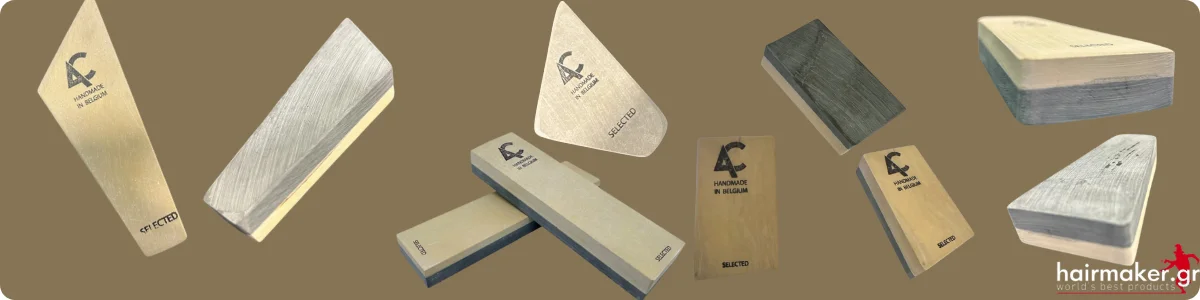
Straight Razor Sharpening Stones

The straight razor is not simply a shaving tool — it's an entire ritual ✔️. An object with history, technique, and character that demands care, patience, and knowledge. In today's fast-paced world, the straight razor is making a powerful comeback as a slow, mindful, and enjoyable experience that connects a man with tradition and himself.
This article aims to initiate you not only in its use, but also in the deeper principles of maintenance and honing, so that your blade remains sharp, safe, and functional for decades ✨. Knowledge is the key — and here begins your journey into the world of the ultimate shaving blade.
The straight razor is not just a blade; it's a return to a technique that demands skill, concentration, and true knowledge of shaving. Many choose it today not only for the precision of the cut, but also for the experience. The ritual of honing, the stropping before the shave, the feel of the blade on the skin — everything comes together to create a process that brings a man closer to traditional grooming.
Unlike modern safety razors or disposables, the straight razor has one significant difference: it doesn't rely on replaceable blades. If properly maintained, a quality razor can last for decades. This dramatically reduces long-term costs while also minimizing environmental impact, as no continuous plastic or metal waste is generated.
The blade, made from high-quality steel, can be revived countless times through honing and stropping. With each proper sharpening process, the perfect edge is revealed again, offering a shave that is deeper, cleaner, and more controlled than any modern blade system. Thousands of users worldwide report that the result is unmatched, while cuts and irritation are significantly reduced — as long as the blade is properly sharpened and aligned.
The straight razor also allows complete control over the cutting angle. This means one can handle difficult areas of the face, such as under the jaw or around the mustache, with greater precision. However, the straightness of the blade requires good technique — and therein lies the beauty of the process: every shave is a small ritual, and every user gradually becomes more skilled.
Another important element is the sense of "ownership." The straight razor, unlike cartridge systems, becomes a man's personal tool. You clean it, maintain it, sharpen it, store it. It acquires character, it acquires history. Some pass it down from generation to generation — and that alone shows how special it is.
If there's one thing that separates experienced straight razor users from beginners, it's a deep understanding of honing. Honing is not just a technique — it's the "heart" of the entire experience. A properly honed razor glides over the skin with incredible ease, cuts hair without resistance, and delivers a shave that is clean, comfortable, and impressively close.
Conversely, a razor that has lost its proper edge can cause tugging, redness, and even micro-cuts that not only ruin the result but also put the skin at risk. Many users assume the razor "isn't good" when in reality it simply needs a proper stropping or honing process — two techniques that revive the edge and bring the tool back to peak performance.
With stropping, the blade is realigned. No metal is removed, the blade's geometry doesn't change — only micro-imperfections created during each use are corrected. The strop acts as a "reset" before each shave, making the blade ready and precise. Honing, on the other hand, is a deeper process where the blade is actually "worked" on a stone, removing material and restoring a new, clean, and perfect edge.
Blade maintenance is not just a matter of practicality; it's also economy. If you handle a straight razor correctly, you may never need to buy another blade again. This transforms it into an investment that pays off over time — and this is why thousands of wet shavers declare that the straight razor is the "king" of grooming.
But the most important thing? The feel. The skin "senses" good honing. An experienced user can tell the difference from the very first stroke of the blade. The shave becomes quieter, cleaner, and with remarkably less effort.
The best tools to start safely and precisely.
Before deciding if honing is needed, one must learn to "read" the blade. A straight razor doesn't wear out suddenly; it sends small signals. If you learn to recognize them, you'll always shave comfortably, without tugging and irritation.
The following tests form the "alphabet" of every traditional shaver. They're simple, quick, and can be done at home before every shave.
The arm hair test remains the most "honest" method. All you have to do is pass the blade gently over a small area of your arm. If it cuts with minimal contact, you're ready to shave. If it tugs the hair, the blade needs stropping — or honing.
The hanging hair test (HHT – Hanging Hair Test) is a favorite of many. You rest a hair vertically against the edge. If the blade cuts it before touching the spine, the edge has proper geometry. If it slides over without cutting, you have some work ahead.
Although the thumb or nail tests are traditional, they're not recommended for beginners. They require experience, a light touch, and familiarity with the feel of the blade.
Every straight razor needs two things: proper stropping before shaving and careful honing every few months. The two techniques work together to keep the edge healthy, symmetrical, and sharp.
Honing, on the other hand, is the actual sharpening process. It's done on stones of different grit and "rebuilds" the edge. This is the step that gives the razor the sharp, clean geometry it needs.
The razor rarely "shouts" that it needs honing. It usually whispers. However, if you learn to recognize the signs, you'll always have a razor that cuts cleanly without hurting the skin.
Generally, for those who shave daily, honing every 3–6 months is considered ideal. For occasional use, the need arises less frequently. There's no absolute schedule here; only the feel of the blade.
To have a razor that "glides" on the skin, you need a small but valuable collection of tools. Stones, strops, and maintenance products are what keep the edge alive and the razor functional for years.
Stropping is done before every shave and renews the edge geometry. A good strop can significantly extend the time until the next honing.
The best honing tools for those who take their shaving seriously.
"Honing took my razor to another level ✔️. The lather stayed stable and the blade glided effortlessly."
— Marios K.
(Skin type: normal – no irritation)
"With proper stropping, my skin felt calmer ✨ and the shave had no tugging at all."
— Stefanos L.
(Skin type: sensitive – frequent redness)
"The 8,000 + 12,000 grit honing kept the blade incredibly sharp ✔️. Every pass was enjoyable."
— Dimitris X.
(Skin type: oily – needs cleanliness)
"The strop helped me keep the blade in top condition. The result on the skin? Much more even and comfortable."
— Antonis R.
(Skin type: combination – needs balance)

Subscribe to our newsletter and receive exclusive content about shaving, beards, hair, and men's grooming — with tips we share inside the barbershop.
No spam. Only substance.

Giannis – Owner of HairMania Greece & Founder of HairMaker.Gr
Professional hairdresser with 25 years of experience in hair and beard care. Owner of HairMania Greece and founder of HairMaker.Gr.
Through HairMaker.Gr I share experiences, product tests, and real applications from the barbershop — with the goal of providing clear knowledge and premium care to the modern man.
Questions about hair or grooming? info@hairmaker.gr
Follow us:
@hairmakergr | @hairmaniagr




Comments (0)