Shopping Cart
There are no more items in your cartOpen Comb Safety Razors
Showing 37-38 of 38 item(s)
Συχνές Ερωτήσεις & Απαντήσεις
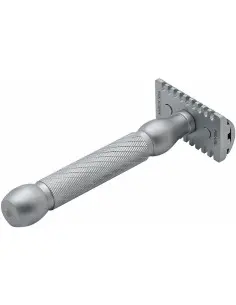
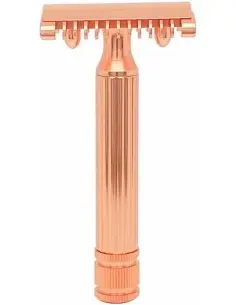
If you see Open Comb and Closed Comb on safety razors and don't understand what changes in practice, the difference is in the head — specifically how the blade meets the hair. An Open Comb has teeth instead of a solid safety bar, which leaves more blade exposed and allows hair and lather to pass freely between the teeth. This means fewer clogs and more efficient cutting on thick stubble — but it requires a more careful angle and lighter pressure than a Closed Comb. The shave feels more direct, and for heavy beards that's exactly the point.
If you've read that Open Combs are "aggressive" and you're worried about nicks, the truth is that aggressiveness depends more on the specific razor than on the comb type alone. There are Open Comb razors with moderate blade gaps that shave very smoothly — not all of them are aggressive. What you need is correct angle (around 30 degrees), zero pressure on the skin, and good lather. If you follow those three basics, a mild-to-medium Open Comb can absolutely work as your first safety razor. The comb style doesn't automatically mean danger.
If you have thick, coarse stubble that clogs Closed Comb razors and forces you through multiple passes for a clean result, the Open Comb was designed with your beard in mind. The teeth allow coarse hairs to reach the blade without piling up, which means fewer passes and less irritation overall. If you leave 2-3 days between shaves or trim your beard line regularly, the open tooth design handles longer hair growth far better than closed guards — where stubble tends to jam and drag.
If you don't know what blade gap means or why it matters, it's the distance between the blade edge and the teeth of the comb — and it determines how "aggressively" the razor shaves. For daily shaving or if you're new to Open Combs, a blade gap of 0.80-0.95mm delivers effective cutting without excessive risk. For thick beards and shaving every 2-3 days, 1.00mm+ handles longer stubble more comfortably. If you're unsure, start with a moderate gap and experiment with different blades — the blade choice changes the feel dramatically.
If you assume the sharpest blade is always the best choice, that's not necessarily true with Open Combs — the razor's geometry already does much of the work due to the increased blade exposure. If your razor is aggressive (large blade gap), start with a medium-sharp blade to avoid irritation. If the razor is mild-to-medium, a sharper blade (Feather, Kai) takes better advantage of the open comb design. The right combination of razor and blade is found only through testing — which is why many shavers start with a sampler pack of different brands.
If you're completely new to traditional wet shaving, the Open Comb isn't the most common first choice — but it's not off-limits either. If you have thick stubble and shave every 2-3 days, a moderate Open Comb with a 0.85-0.95mm blade gap can work well as a first razor. If your beard is normal or sparse, start with a Closed Comb that forgives technique mistakes more easily, and try an Open Comb later once you're confident with angle and pressure. The key is matching the razor to your beard, not following a fixed rule.

If you're looking for reliable Open Comb safety razors from established manufacturers, with detailed specifications on blade gap, material, and weight, HairMaker.Gr carries a curated selection across different aggressiveness levels. Every razor includes a full description so you can match it to your beard type and experience level. Worldwide shipping available on all orders.