
Shopping Cart
There are no more items in your cart




Directly In Stock
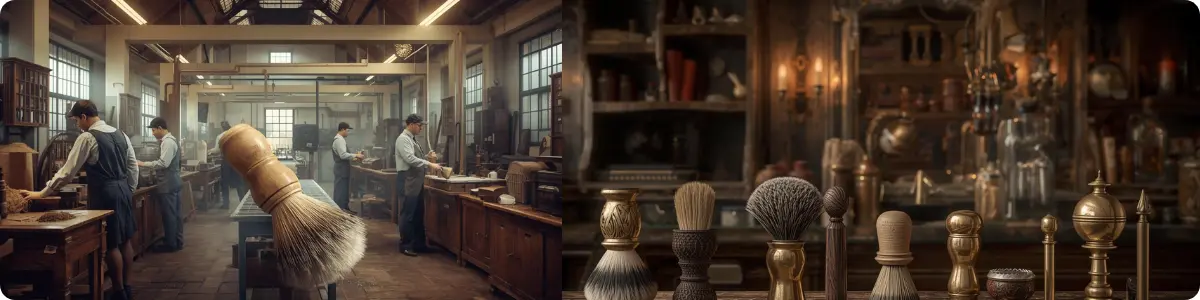
The shaving brush is not merely a tool of daily use. From the earliest years of human history, facial grooming was connected to social image, self-discipline, and self-respect ✔️. Shaving gradually evolved from a practical necessity into a ritual, where the process held almost the same significance as the result.
As centuries passed, the shaving brush acquired symbolic character in barbershops and men's homes, representing patience, care, and quality ✨. Its history reflects cultural changes and explains why it remains an integral part of the traditional shaving experience to this day.
The history of the shaving brush cannot be separated from the broader evolution of grooming tools in ancient civilizations. Long before the concept of "cosmetics" emerged, people sought ways to keep their faces and bodies clean, both for hygiene reasons and social acceptance. In ancient Egypt, for example, shaving was an act of cleanliness and spiritual discipline, while oils and ointments were used to soften the skin before the procedure.
In ancient Greece and later in Rome, facial grooming was directly connected to the image of the free citizen. Shaving was not merely a practical necessity but an indication of civilization and order ✨. Although the brush in its modern form did not yet exist, fabrics, sponges, and natural materials were used to apply soaps or oils, preparing the skin before shaving.
These early practices reveal something essential: shaving was treated as a ritual from the beginning, not as a hasty act. The need for uniform product application and better blade control laid the foundation for the evolution of specialized tools. The shaving brush, as it would appear later, was born from this very need for precision, care, and respect for the skin ⚠️.
The invention of the shaving brush was not the result of aesthetic luxury, but practical necessity. As shaving soaps began to be used more systematically, it became clear that proper skin preparation was crucial for a comfortable and safe shave. Simple application by hand could not offer the required uniformity nor effectively "lift" the hairs.
The brush came to solve precisely this problem ✔️. Natural bristles, thanks to their elasticity and ability to retain water, allowed the creation of rich lather and gentle exfoliation of the skin. This way, the blade glided more easily, reducing irritation and cuts. The process became slower, more conscious, and clearly more qualitative.
At the same time, the shaving brush introduced a new dimension to grooming: the relationship between man and tool. It was no longer just an object of use, but an extension of the user's technique and experience ⚠️. This transition from utilitarian to ritualistic is why the brush acquired timeless value and maintained its position even in times of intense technological evolution.
The shaving brush was not created simply to spread lather. It was created to slow down time, give value to the process, and transform shaving from obligation into personal ritual ✨.
This philosophy lives on today through the choice of the right shaving brush—one that balances technique, feel, and respect for the traditional shaving process.
During the Middle Ages, shaving temporarily moved away from most men's daily routines, without disappearing completely. Facial grooming became more associated with monastic communities, physicians, and professional barbers, who maintained practices and tools that passed from generation to generation. In this period, knowledge was not widespread; it was concentrated in few hands and treated as a technical skill.
Early brushes did not yet have a standardized form ✨. Bundles of natural bristles, fabric, or sponges were used, serving the same basic purpose: to prepare the skin before contact with the blade. The concept of comfort began to gain importance, as barbers understood that a well-prepared face reduced cuts and inflammation.
Gradually, the brush transformed into a tool of professional identity ⚠️. The barber who possessed proper tools and technique stood out from the simple blade operator. Thus, the shaving brush began to be associated with experience, care, and reliability — values that would define its evolution in subsequent centuries.
The Middle Ages did not eliminate grooming; it simply concentrated it in the hands of specialists, preparing the ground for the professional renaissance of shaving.
The 18th and 19th centuries marked a decisive turning point for the history of the shaving brush. The rise of cities, improvement of materials, and emergence of organized workshops radically changed the perception around personal grooming. Shaving moved from the realm of necessity to the realm of choice, and with it evolved the tools.
During this period, the brush began to acquire recognizable form ✔️. Wooden or bone handle, carefully bound with natural bristle, designed for durability and comfort. The lathering process became more controlled, more efficient, and clearly more enjoyable. Grooming began to be associated with the concept of quality of life.
Meanwhile, barbershops transformed into social spaces ⚠️. There, the shaving brush was not just a tool, but part of an experience: conversation, time, trust. This cultural shift explains why the brush maintains its position to this day, even when technology offers faster solutions.
The concept of the oldest brush company is not a simple matter. It's not only about age, but consistency in technique, continuity in knowledge, and historical documentation that endures through time ✨.
The evolution of the shaving brush is inextricably linked to its materials. For centuries, natural bristle formed the core of the experience: water retention, elasticity, and gentle contact with the skin. These characteristics allowed the creation of stable lather and preparation of hair for clean blade passage. It wasn't about luxury; it was about functionality.
With the progress of industry and material technology, synthetic fibers appeared ✨. Durability, stability, and ease of maintenance brought new options to the table. Nevertheless, the essence of the brush remained the same: proper bloom, control, and rhythm in lather application. Material choice became a matter of preference and usage philosophy, not simple replacement.
The critical point is not opposition, but continuity ⚠️. Each material carries a story and serves different needs. The existence of options shows that the shaving brush hasn't "stuck" in the past; it evolved without losing its character.
The value of a brush is not measured only by its material, but by how it serves the shaving ritual.
In modern times, the shaving brush has experienced a quiet but substantial return. Not as a reaction to technology, but as a choice of consciousness. Those who turn to traditional shaving seek rhythm, control, and quality contact with the skin. The brush functions as a bridge between past and present, without exaggeration.
In modern barbershops and the homes of those who appreciate grooming, the process regains depth ✔️. Lather is worked with patience, the face is properly prepared, and time gains value. This is not about nostalgia, but about restoring essence to a daily act that was often undervalued.
The shaving brush remains relevant because it serves a need that doesn't change ⚠️: respect for the body and the process. As long as this need exists, the brush will continue to have a role — not as fashion, but as a stable point of reference.
The shaving brush survives because it serves man, not time. It's a tool that carries experience, not a promise of speed ✨.
The history of the shaving brush did not evolve in isolation, but parallel to the technological advancement of shaving tools. Every change in blade, shape, or tool materials created new requirements for skin preparation. The brush functioned as a stable link in this chain of evolution, adapting to the needs of each era without losing its character.
As blades became more precise and demanding in use, the importance of proper preparation increased ✨. The brush assumed a regulatory role: it ensured that the skin was hydrated, hairs properly oriented, and lather evenly distributed. It was never replaced by technology, because it served not only a technical need, but human sensation.
This coexistence of tool and technique shows why the brush survived in periods of radical changes ⚠️. It wasn't merely an accessory, but a basic element of control and experience, regardless of how advanced the rest of the shaving system became.
Beyond materials and functionality, the shaving brush embodies the concept of craftsmanship. For centuries, its construction required knowledge, patience, and precision, elements directly connected to the craftsman's identity. The selection, binding, and shaping of bristle were not random; they were part of an unwritten expertise that passed from hand to hand.
In barbershops, this tradition became visible in practice ✔️. The brush was not just a tool, but a symbol of professionalism and trust. The way it was used, the rhythm of movements, and the care after use were part of a culture that transcended the result of shaving.
The preservation of this mindset is why the brush continues to have a place in modern grooming ⚠️. It doesn't represent only the past, but an attitude toward care: respect for the process, technique, and person.
"Natural bristle brush retains more water and gives a more 'full-bodied' lather, ideal for slow and careful shaving."
— Traditional user
(Emphasis on ritual & sensation)
"Synthetic fibers are more stable, dry quickly, and offer consistency in every use without special care."
— Modern user
(Practicality & daily use)
"In the barbershop, the brush is an extension of the barber's technique; the way of lathering shows experience and respect for the client."
— Professional barber
(Rhythm, control, trust)
"At home, the brush helps slow down time and transform shaving into a personal moment of care."
— Home shaver
(Comfort & conscious process)
The history of the shaving brush doesn't end here. In every era, the method, materials, and habits change, but not the reason for its existence. It remains a tool that connects care with time, technique with experience, and daily shaving with something deeper than a simple habit.

Subscribe to our newsletter and receive substantial content on shaving, beards, and men's grooming — as we share it inside the barbershop.
No spam. Only substance.

Giannis – Owner of HairMania Greece & Founder of HairMaker.Gr
Professional hairdresser with 25 years of experience in hair and beard care. Owner of HairMania Greece and founder of HairMaker.Gr.
Together with the HairMaker.Gr team, I publish articles based on real tests, customer feedback, and daily barbershop experience.
Questions about hair or grooming? Send email to info@hairmaker.gr .
Follow us:
@hairmakergr | @hairmaniagr


 2 Review(s)
Comments (0)